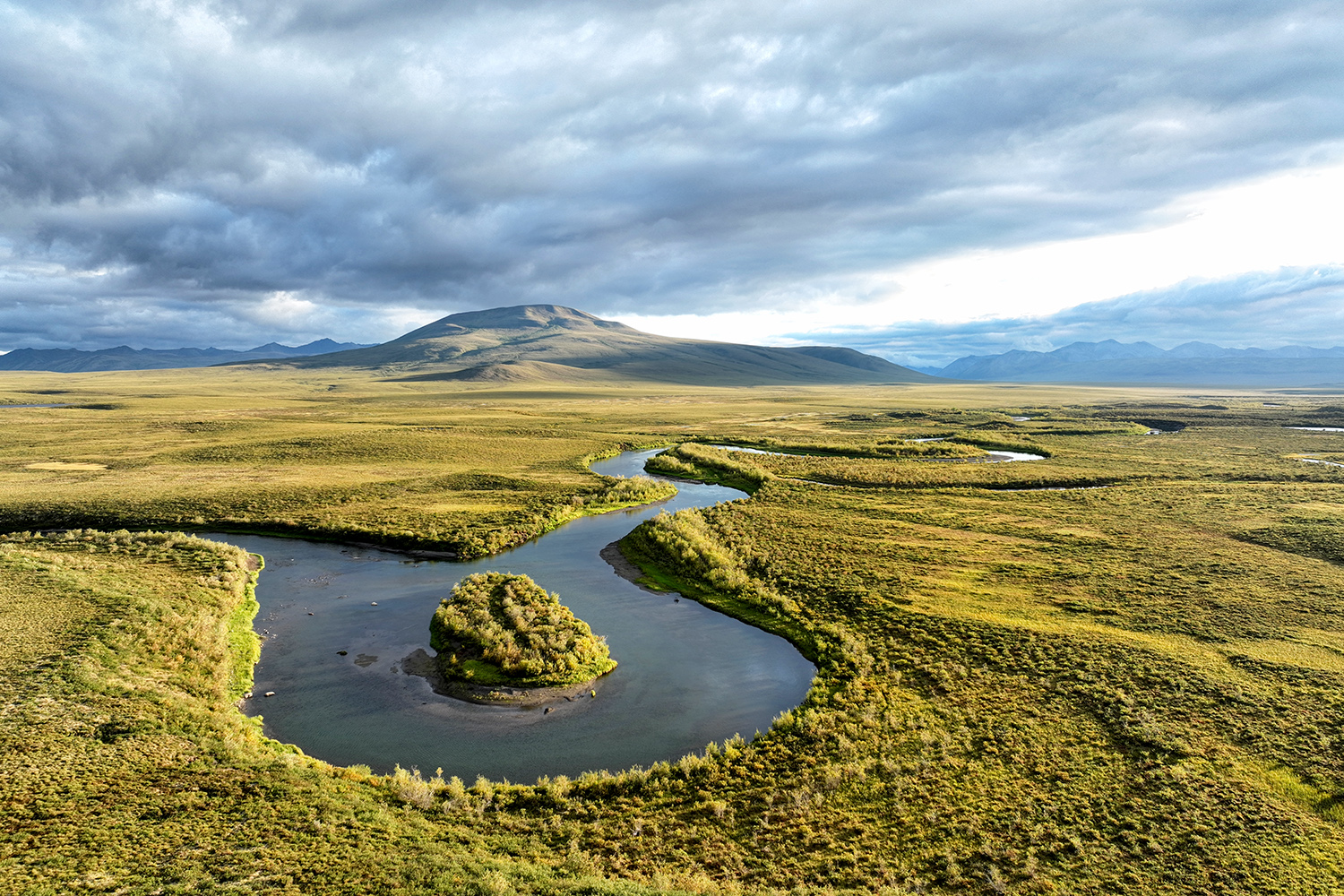
Blackstone River, Tombstone Territorial Park, Yukon, Canada. Credits: Saskia Eppinger, TUM (2023).
About GTN-P's International Stewardship
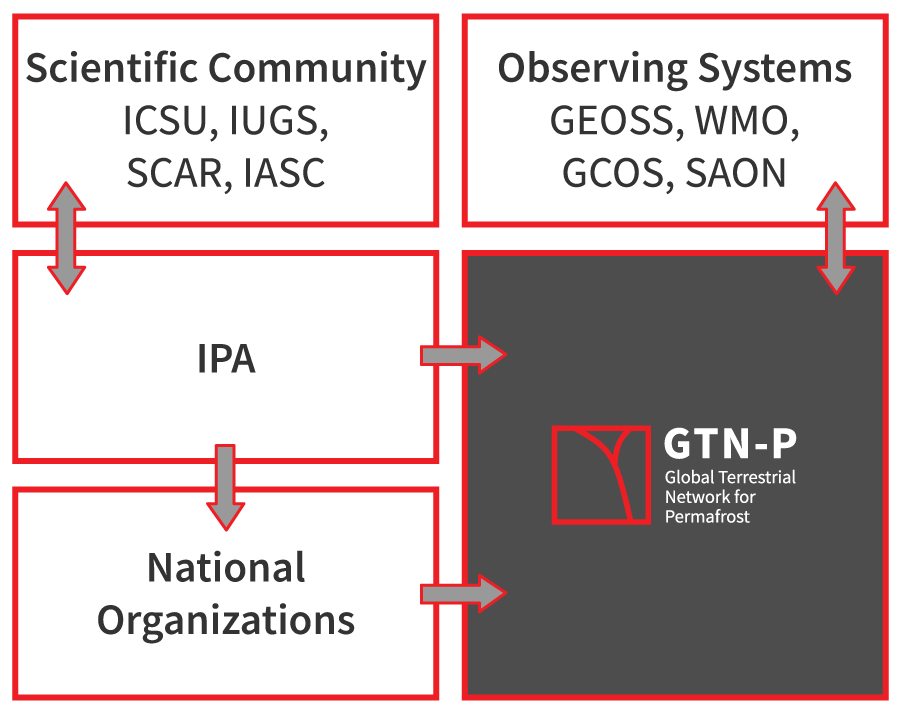
GTN-P involvement in the international Observing Systems network.
GTN-P was established in the late 1990s as a bottom-up initiative and was first led by the International Permafrost Association (IPA) as part of GCOS, in support of the UNFCCC. Its goal is to meet the observational needs of the global scientific permafrost community by providing a comprehensive view of the spatial structure, trends, and variability in global permafrost conditions. Since 2011, GTN-P is based at the AWI and has been supported by third party funding since then. Today, GTN-P plays a central role in the global scientific community, in which it is deeply rooted. With a robust governance structure, including an International Office led by the AWI, its work and success is recognized by other GCOS global terrestrial networks, international organizations, such as the WMO, and the scientific community.
The GTN-P community consists of permafrost scientists from 26 countries, with a strong representation of Early Career Researchers. GTN-P covers the Arctic, Antarctic, and an extensive mountain permafrost network, including the Third Pole. GTN-P includes a total of 1,386 boreholes and 255 active layer sites. Datasets from these monitoring sites play a critical role in reporting the global climate evolution, for example in WMO and BAMS reports. GTN-P data are crucial in validating global climate projections. They serve for validation and calibration of large satellite-derived data products, such as the operationalization of permafrost observing in the ESA Copernicus framework, and support numerous scientific publications - Google Scholar lists more than 800 scientific contributions containing GTN-P data, or network activities. GTN-P time-series observations of permafrost evolution serve as valuable input for Earth System Models, underpinning the global relevance of the GTN-P data.