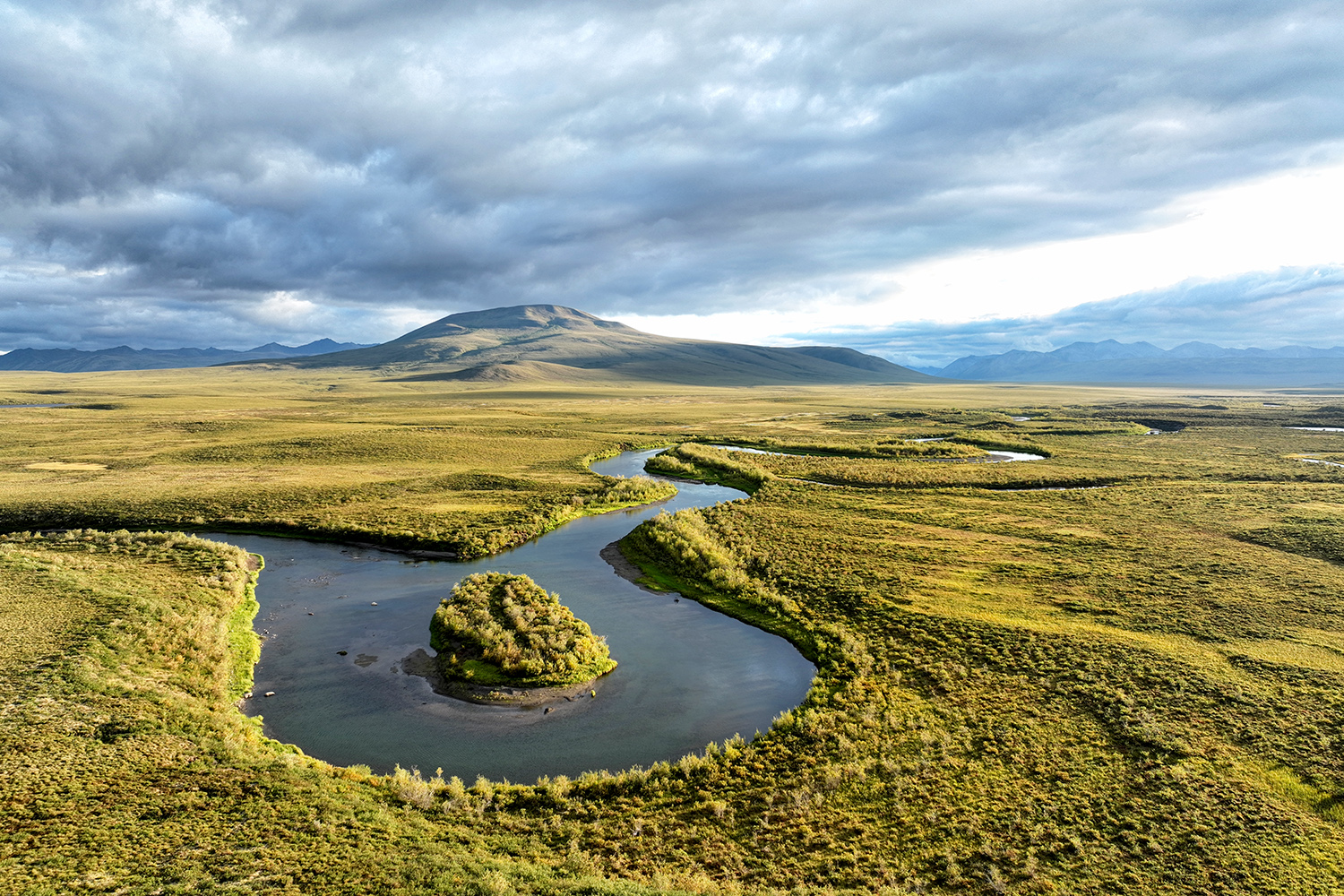
Blackstone River, Tombstone Territorial Park, Yukon, Canada. Credits: Saskia Eppinger, TUM (2023).
About the History of GTN-P
The GTN-P was founded in 1999. It was developed in the 1990s by the Terrestrial Observation Panel for Climate (TOPC) and implemented by the International Permafrost Association (IPA) under the Global Terrestrial Observing System (GTOS) as part of the Global Climate Observing System (GCOS) in support of the United Nations Framework Convention on Climate Change (UNFCCC).
The PT database was originally hosted at the Geological Survey of Canada (GSC) in Ottawa. The PT observatories in the United States and Russia were supported by the US National Science Foundation and managed by the Permafrost Laboratory at the University of Alaska Fairbanks.
ALT measurements available at the GTN-P data platform are in large parts also part of the Circumpolar Active Layer Monitoring (CALM) programme. CALM was established in 1991 and initially affiliated with the International Tundra Experiment (ITEX). Through funding from the National Science Foundation (NSF), CALM has had operational bases at Rutgers University (1991-1994), the State University of New York (1994-1997) the University of Cincinnati (1998-2003), the University of Delaware (2003-2009), and is currently headquartered at the George Washington University.
Historical data from PT and CALM are available from the National Snow and Ice Data Center in Boulder, Colorado (NSIDC), and Advanced Cooperative Arctic Data and Information Service (ACADIS), and NSF Arctic Data Center. The U.S. Geological Survey has established an array of climate-monitoring stations in Arctic Alaska as part of the U.S. Department of the Interior/Global Terrestrial Network for Permafrost (DOI/GTN-P) Observing System in 1998 (Urban and Clow, 2021) and continues temperature monitoring of the DOI/GTN-P Deep Borehole Array with some sites dating back to 1973 (Clow, 2014).
During the International Polar Year 2007-2008 (IPY) the IPA coordinated and strengthened the collection of permafrost temperature data in the PT project focusing on a first global snapshot. A database and map of mean annual ground temperatures for 600 boreholes from all permafrost areas, including high-altitude locations outside the polar regions, became available online in an ISO-compliant format at the National Snow and Ice Data Center (NSIDC). This provided a baseline for measuring future changes. Synthesis papers were published at the end of IPY in a special issue of the journal Permafrost and Periglacial Processes (e.g., Smith et al. 2010, Romanovsky et al. 2010 a, b, Christiansen et al. 2010, Vieira et al. 2010, and Brown, 2010, Zhao et al., 2010); followed by an IPY legacy permafrost observatory report (Brown and Christiansen, 2012). The progress of the CALM program is summarised in Shiklomanov et al. (2008, 2012) and CALM special issues in Polar Geography in 2000 (Brown et al., 2000) and Permafrost and Periglacial Processes in 2004 (e.g., Nelson et al., 2004).
From the very beginning, efforts had been made within the IPA to include permafrost in rugged mountain topography at lower latitudes/higher altitudes (Haeberli et al. 1993, 1998). Particularly, the EU Permafrost and Climate in Europe (EU-PACE) project, systematically established a series of 100 m deep boreholes for long-term observation of permafrost thermal conditions along a continental-scale longitudinal transect from Svalbard through Scandinavia and the Alps to the Sierra Nevada in Spain (Harris et al. 2001, 2003). The EU funded PermaNET project (2007-2011) further supported the development of a comprehensive network of permafrost monitoring sites throughout the European Alps (Mair et al. 2011).
The continued involvement of individual permafrost scientists and relevant stakeholders is assured through their participation in GTN-P meetings and workshops. The first of these workshops took place in the fall of 2011 and was followed by three technical workshops in February, September and November 2012. The workshops, partially funded by the PAGE21 project, focused on the needs and technical requirements of GTN-P data providers and users. These include field scientists, modellers, ecologists, engineers, other scientific communities, observing networks, lecturers, students, the public, and policy-makers.
The first GTN-P Strategy and Implementation Plan was produced in 2012 (GTN-P, 2012). The document outlined the governance structure of the network, defined roles and responsibilities of the National Correspondents (NC), the Executive Committee (later renamed to Steering Committee, SC) and the Advisory Board (AB). The governance structure was put in place in spring 2013. The first meeting of the NCs was held at the WMO Headquarters in Geneva in early May 2013. Of the 25 countries formally included in the GTN-P, 18 countries were represented. The second meeting took place in Quebec in September 2015 and largely focused on developing data standards and protocols. It was attended by 28 participants from 16 countries (Lewkowicz et al., 2016). Major progress was made to establish the GTN-P Office, to improve the data management system, data policy and standards, and to increase sustainability of the GTN-P network by introducing Young National Correspondents (YNC). The YNC were formally elected during the GTN-P meeting held at the Eleventh International Conference on Permafrost (ICOP) in Potsdam, Germany in June 2016.
Over the last decade, GTN-P made considerable progress from a grassroots organization towards a more structured and operational GCOS entity. The GTN-P core group that formed during the EU project PAGE21 (2011-2015) successfully established a governance structure and a functional body providing the current baseline network of people for the observation of the Permafrost ECV. It is critically important to capitalize on the previous accomplishments and to secure the future and sustainability of the GTN-P network. Close collaboration with existing and the establishment of new national or regional permafrost centres to collect, analyse and process data is critical for the continued success of the GTN-P network, since such networks are essential for data collection and management on a regional to country level.