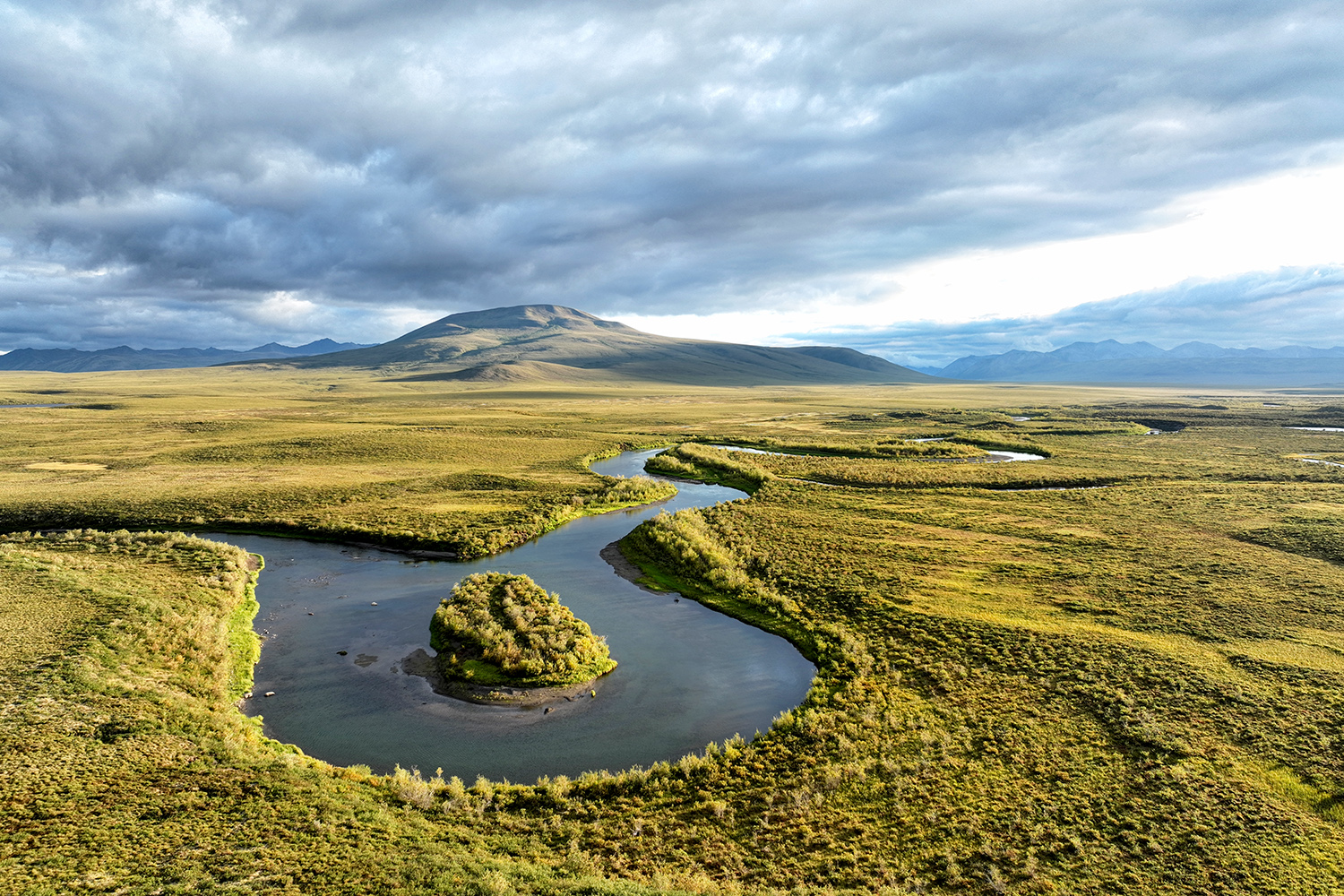
Blackstone River, Tombstone Territorial Park, Yukon, Canada. Credits: Saskia Eppinger, TUM (2023).
About the Permafrost Shared Arctic Variable (SAV)

Illustration of Shared Arctic Variables (SAVs). Source: Starkweather et al. (2021), DOI: 10.14430/arctic74330. © 2021 ARCTIC. Licensed under CC BY 4.0.
Shared Arctic Variables (SAVs) are a coordinated set of key variables identified through the Sustaining Arctic Observing Networks (SAON) Roadmap for Arctic Observing and Data Systems (ROADS) process to promote harmonized, multidisciplinary observing across the Arctic (SAON, 2018; Larsen et al., 2019). SAVs are selected based on their scientific importance, societal relevance, and feasibility of sustained observation, with the aim of improving data interoperability, reducing fragmentation among observing systems, and maximizing the value of Arctic observations for research, Indigenous knowledge co-production, and decision-making. Rather than replacing existing frameworks such as Essential Climate Variables, SAVs complement them by focusing specifically on Arctic priorities and by encouraging coordination across national, disciplinary, and organizational boundaries.
Permafrost qualifies for a Shared Arctic Variable due to its fundamental role in Arctic landscapes and its strong sensitivity to climate change (SAON, 2020). The Permafrost SAV is currently being developed by a team of researchers from SAON, U Aarhus, UNIS, NRCan, U Vienna, U Oulu and AWI together with the Community of Svalbard (Norway) and the Community of Tuktoyaktuk (Northwest Territories, Canada).
The participation of the Global Terrestrial Network for Permafrost (GTN-P) in the establishment of the Permafrost Shared Arctic Variable (SAV) ensures that community-defined observing priorities and internationally coordinated permafrost measurements are jointly being seen and coordinated. Engagement with the Permafrost SAV enables GTN-P to broaden its horizon and thereby its observing framework by integrating societal benefit perspectives, Indigenous and local knowledge, and place-based priorities, thereby increasing the relevance, usability, and impact of permafrost observations for Arctic communities and decision-making.
References
- SAON (2018): A Framework for Shared Arctic Variables. Sustaining Arctic Observing Networks.
- Larsen, J. N., et al. (2019): Arctic Observing: Sustaining Arctic Observing Networks (SAON) and the Roadmap for Arctic Observing and Data Systems (ROADS). Arctic Science, 5(2), 71–90. DOI: 10.14430/arctic74330
- SAON (2020): Shared Arctic Variables: Process and Initial Results. Sustaining Arctic Observing Networks.