

Blackstone River, Tombstone Territorial Park, Yukon, Canada. Credits: Saskia Eppinger, TUM (2023).
About the Permafrost Essential Climate Variable (ECV)
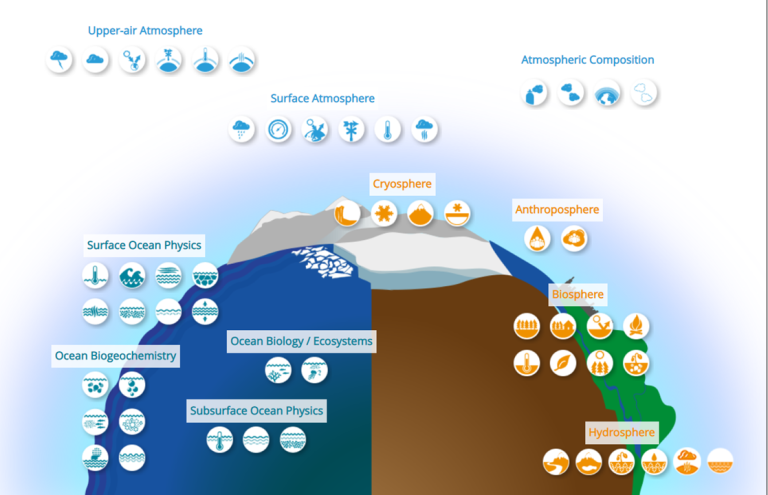
Illustration showing all Essential Climate Variables (ECVs). Credits: WMO.
Essential Climate Variables (ECVs) are a defined set of physical, chemical, and biological variables identified by the Global Climate Observing System (GCOS) as being critical for characterizing the state and evolution of the Earth’s climate system (GCOS, 2016; Bojinski et al., 2014). They are selected based on their scientific relevance to climate processes and change, as well as the technical feasibility, cost-effectiveness, and long-term sustainability of their global observation. ECVs provide a standardized framework that underpins climate monitoring, model evaluation, and climate services by ensuring that observations are consistent, comparable, and traceable across regions and time. Permafrost is one of the cryosphere ECVs and is defined as ground that remains at or below 0 °C for at least two consecutive years (GCOS, 2022).
The Permafrost ECV focuses primarily on three so called quantities – permafrost temperature, active layer thickness and rock glacier velocity – which together describe the thermal condition and stability of frozen ground. Monitoring permafrost is particularly important because it is highly sensitive to atmospheric warming, and its degradation can trigger ground subsidence, damage to infrastructure, changes in ecosystems, and the release of greenhouse gases such as carbon dioxide and methane, thereby creating a positive feedback loop which further amplifies climate change (Schuur et al., 2015).
GCOS affiliation

In 2026, GTN-P became a GCOS Affiliated Network. These networks are internationally recognized observing systems that deliver sustained, high-quality observations of Essential Climate Variables (ECVs) in accordance with GCOS standards and requirements. Through this affiliation, GTN-P further strengthens the coordination, consistency, and long-term sustainability of global permafrost ECV observations. (WMO, 2026)
References
- GCOS (2016): The Global Observing System for Climate: Implementation Needs. GCOS-200.
- Bojinski, S., et al. (2014): The concept of Essential Climate Variables in support of climate research, applications, and policy. Bulletin of the American Meteorological Society, 95(9), 1431–1443. DOI: 10.1175/BAMS-D-13-00047.1
- GCOS (2022): Systematic Observation Requirements for Satellite-based Products for Climate: 2022 Update. GCOS-245.
- Schuur, E. A. G., et al. (2015): Climate change and the permafrost carbon feedback. Nature, 520, 171–179. DOI: 10.1038/nature14338
- WMO (2026): Global Climate Observing System (GCOS): Networks. URL: https://gcos.wmo.int/site/global-climate-observing-system-gcos/networks